
A few years ago, building an AI product required research teams, expensive infrastructure, and enough GPUs to make your electricity bill look suspicious.
Now you can connect an API to a frontend over a weekend and call yourself an AI startup by Monday.
That accessibility is real. It’s also slightly deceptive.
Because the technical barrier to building AI software has collapsed faster than the business barrier. Plenty of people can ship demos now. Far fewer can build products that survive actual usage.
The difference usually comes down to one thing:
Useful AI products solve workflow problems, not curiosity problems.
That distinction matters more than the model you choose.
Step 1: Start With a Painfully Specific Problem
Most failed AI SaaS ideas start too broad.
Things like:
- “AI for productivity”
- “AI assistant for everyone”
- “smart business automation”
- “AI-powered content platform”
These sound ambitious but often hide weak product thinking.
A stronger starting point looks more like:
- helping recruiters summarize candidate interviews
- automating compliance reports for logistics companies
- generating customer support replies from internal documentation
- extracting invoice data from messy PDFs
The narrower the initial workflow, the easier it is to:
- validate demand
- improve outputs
- measure value
- market the product
Ironically, narrow products often expand faster later because they develop credibility first.
If I were starting an AI company today, my positioning would be similar to what I describe in If I Had to Start an AI Business in 2026, I Wouldn't Build Another Chatbot.
Step 2: Don’t Train a Model Unless You Absolutely Need To
This is one of the biggest beginner mistakes in AI startups.
People assume “real AI companies” train their own models.
Most shouldn’t.
Why APIs Changed Everything
Modern foundation models are already extremely capable.
Using APIs from providers like:
- OpenAI
- Anthropic
- open-source inference platforms
lets you focus on:
- workflows
- UX
- integrations
- customer problems
- reliability
instead of spending millions on infrastructure.
Training custom models only makes sense if:
- you have proprietary data
- latency requirements are unusual
- costs become enormous at scale
- the domain is highly specialized
Otherwise, building on existing models is usually the rational choice.
A surprising number of successful AI businesses are operational companies built on top of commodity intelligence.
Step 3: Build Around a Workflow, Not a Chat Window
This is where many AI SaaS products quietly fail.
They build a chatbot and assume users will figure out how it fits into work.
The hardest part of building a company is rarely the technology itself. More often, it's getting users, which is why The First 100 Users Are Harder Than the First $1,000.
Most people won’t.
The Problem With Generic Chat Interfaces
Chat is flexible, but flexibility creates cognitive effort.
Users still need to:
- structure requests
- provide context
- evaluate outputs
- manage formatting
That’s fine for power users. Less fine for busy teams.
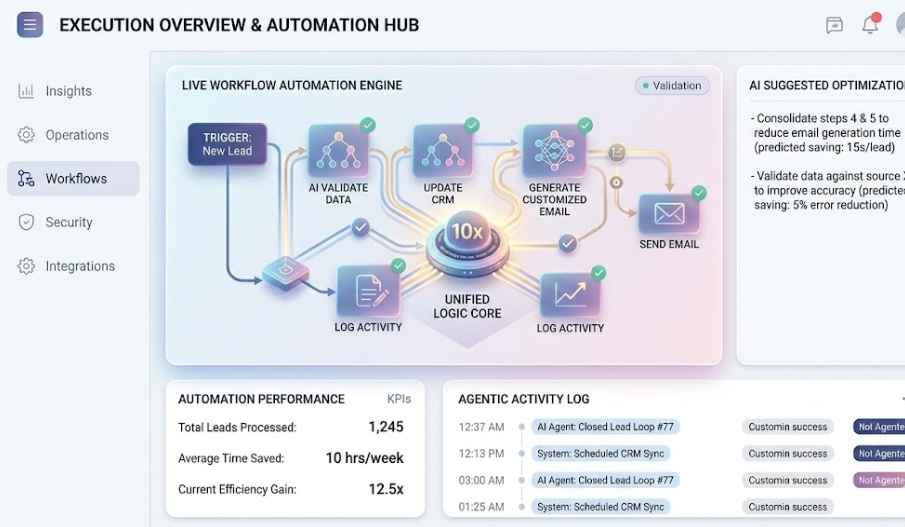
Instead of asking users to “talk to AI,” design workflows where AI disappears into the task itself.
For example:
- auto-generating CRM notes after calls
- drafting contracts from intake forms
- summarizing meetings automatically
- categorizing support tickets in the background
The best AI products often feel less like AI products over time.
They just feel efficient.
Step 4: Treat Data Structure as a Product Advantage
Most beginners focus heavily on prompts and models.
Experienced builders eventually realize structured data matters more.
AI becomes dramatically more reliable when the surrounding system provides:
- clean inputs
- defined workflows
- retrieval systems
- constraints
- contextual memory
This is why enterprise AI products are often less impressive in demos but more useful in practice.
A Non-Obvious Truth
Good AI products are frequently disguised data systems.
The AI layer gets attention. The data architecture quietly determines quality.
If outputs feel inconsistent, the issue is often not the model. It’s weak context management.
Step 5: Build Retrieval Before Fine-Tuning
When AI gives bad answers, beginners often jump immediately toward fine-tuning models.
That’s usually premature.
In many cases, the real problem is missing context.
Why Retrieval-Augmented Generation (RAG) Matters
RAG systems allow AI to pull relevant information from:
- internal docs
- databases
- PDFs
- knowledge bases
- customer records
before generating a response.
This approach is:
- cheaper
- easier to update
- more transparent
- more flexible
than retraining models constantly.
And importantly, it reduces hallucinations by grounding outputs in actual information.
A lot of AI SaaS products become dramatically better once retrieval is implemented properly.
Step 6: Design for Human Review
This is where reality usually collides with AI optimism.
Fully autonomous systems sound impressive in demos. Real businesses tend to prefer controlled automation.
Especially when mistakes are expensive.
Human-in-the-Loop Is Underrated
Strong AI SaaS products often include:
- approval steps
- confidence indicators
- editable outputs
- audit trails
- fallback mechanisms
Not because AI is weak. Because operational trust matters.
The fastest way to lose users is forcing them to double-check everything manually while pretending the system is autonomous.
Ironically, partial automation often creates more value than aggressive automation.
Step 7: Obsess Over Latency More Than Most Founders Do
AI products introduce a new UX problem: waiting.
Traditional SaaS apps feel instant. AI responses can take seconds.
That delay changes user psychology immediately.
Why Speed Changes Perceived Intelligence
Fast AI feels smarter.
Slow AI feels unreliable, even when outputs are technically better.
Good AI SaaS products use techniques like:
- streaming responses
- background processing
- optimistic UI states
- partial generation
- caching
to reduce friction.
A two-second improvement in response time can matter more than a 10% improvement in model quality.
Most users experience AI emotionally before they evaluate it analytically.
Step 8: Don’t Ignore Evaluation Systems
One of the hardest parts of AI SaaS is consistency.
Traditional software either works or breaks. AI systems produce probabilistic outputs.
That changes testing completely.
What AI Teams Eventually Learn
You need ways to evaluate:
- output quality
- hallucination rates
- formatting consistency
- retrieval accuracy
- task success rates
Without evaluation systems, product quality drifts invisibly over time.
This becomes especially important when:
- changing prompts
- swapping models
- adjusting retrieval pipelines
- scaling across customers
A lot of AI startups underestimate this operational complexity early on.
Step 9: Pricing AI Products Requires Different Thinking
Traditional SaaS pricing often maps cleanly to seats or features.
AI products introduce variable costs:
- token usage
- inference expenses
- retrieval costs
- compute spikes
This creates margin pressure quickly.
The Mistake Many Founders Make
Some AI startups underprice products because generation feels “cheap.”
At scale, usage patterns can become surprisingly expensive.
Good pricing models usually balance:
- predictable customer billing
- healthy margins
- usage flexibility
Many companies now combine:
- subscriptions
- usage-based pricing
- credits
- enterprise tiers
because AI cost structures fluctuate more than traditional SaaS.
Step 10: Distribution Still Matters More Than Technology
This part disappoints technical founders every generation.
The best product does not automatically win.
Especially in AI, where capabilities converge quickly.
What Actually Creates Defensibility
Over time, advantages usually come from:
- proprietary workflows
- customer trust
- embedded integrations
- unique datasets
- distribution
- operational reliability
Not the model itself.
Models improve across the entire industry simultaneously. Workflow understanding compounds more slowly.
That’s where sustainable businesses emerge.
The Real Job Isn’t Building AI
Many successful AI products come from addressing practical, overlooked problems, as discussed in Why Solving Boring Problems Can Be a Competitive Advantage.
This is the shift many founders eventually experience.
At first, building an AI SaaS product feels like a technical challenge.
Then the real problems appear:
- onboarding
- trust
- workflow integration
- reliability
- customer education
- operational edge cases
- pricing pressure
In other words, it starts looking suspiciously like normal software business problems again.
AI changes the interface layer dramatically. It changes software economics significantly. It changes product possibilities completely.
But the core challenge remains surprisingly old-fashioned:
Build something people genuinely depend on.
The companies that survive the next few years probably won’t be the ones with the flashiest demos.
They’ll be the ones quietly removing friction from real work while everyone else is still arguing about prompts on social media.