
Most people assume large language models are doing something mystical behind the scenes.
They're not.
At their core, LLMs are prediction machines. They look at text and guess what comes next. Word after word, token after token.
And yet somehow that process produces code, essays, debugging advice, translations, and occasionally disturbingly convincing fake confidence.
That's the weird part.
The Core Idea Is Simpler Than It Sounds
A language model trains on massive amounts of text:
- books
- websites
- documentation
- forums
- code repositories
It doesn't memorize the internet like a database. Instead, it learns statistical patterns in language.
Internally, text gets broken into smaller chunks called tokens.
For example:
text"The capital of France is"
The model predicts the next token:
text"Paris"
Training is basically this loop repeated trillions of times:
- Predict the next token
- Compare against the real answer
- Adjust the model slightly
- Repeat
Simple idea. Ridiculous scale.
If you'd like a deeper explanation of what is happening behind the scenes, read Breaking the Magic: How Large Language Models Actually Work.
Transformers Changed Everything
Modern LLMs use an architecture called the transformer, introduced in the famous paper "Attention Is All You Need".
The key innovation was attention.
Instead of reading text strictly one word at a time, transformers learn which words matter most in relation to each other.
That helps models track context, relationships, tone, and meaning across long passages.
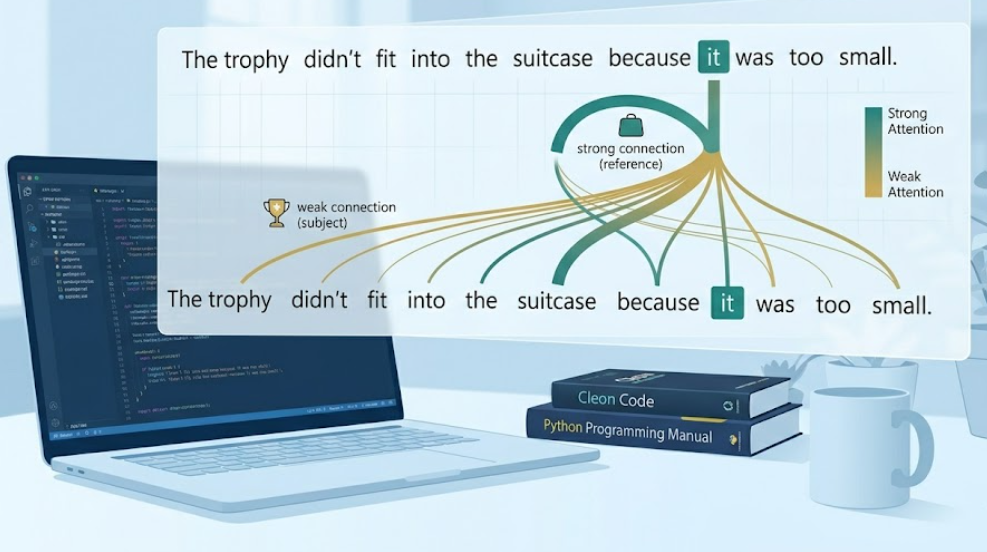
Without transformers, modern AI assistants probably wouldn't exist in their current form.
Why Models Start Looking Intelligent
Here's the surprising part:
To predict language well, the model eventually learns structure hidden inside language itself:
- grammar
- reasoning patterns
- coding conventions
- facts and relationships
- human tone and behavior
It turns out human knowledge is deeply embedded in text.
So even though the model is "just predicting tokens," the scale of training creates surprisingly capable behavior.
This is why LLMs feel intelligent without actually thinking like humans.
They're pattern engines operating at enormous scale.
Hallucinations Aren't a Glitch
One of the biggest misunderstandings about LLMs is hallucination.
Understanding how LLMs work also makes prompt writing much easier, which is why Prompt Engineering Isn't Magic. It's Mostly Clear Thinking is worth reading next.
Models don't retrieve facts the way search engines do. They generate likely text.
Usually that works well.
Sometimes it produces:
- fake citations
- invented APIs
- imaginary statistics
- confidently wrong answers
The model isn't lying intentionally. It's generating plausible continuations.
Truth and plausibility are related, but they're not the same thing.
Why AI Coding Tools Work So Well
Code is unusually friendly to language models:
- it's structured
- patterns repeat constantly
- correctness can be tested quickly
- open-source repositories provide huge datasets
That's why coding assistants improved so fast compared to many other AI applications.
Programming languages are cleaner than human conversation. Machines like clean structure.
Bigger Models Aren't Always Better
A slightly contrarian point: bigger models don't automatically create better products.
In practice, reliability often matters more than raw intelligence.
A smaller model with:
- good retrieval
- clean data
- strong tooling
- careful fine-tuning
can outperform a giant model in real-world tasks.
A lawyer doesn't need an AI that writes poetry. They need one that stops inventing court cases.
The industry is slowly rediscovering this.
The Important Thing to Remember
LLMs are neither magical minds nor useless autocomplete.
They're statistical systems trained on enormous amounts of human language.
That sounds less impressive than "artificial intelligence."
Until you realize human civilization accidentally created a machine that can compress patterns from billions of conversations, documents, arguments, tutorials, and books into a predictive engine.
Which is honestly strange enough already.
The reason these models became possible at all has a lot to do with modern hardware, which I discuss in GPUs Became the Most Important Hardware in AI for One Simple Reason.