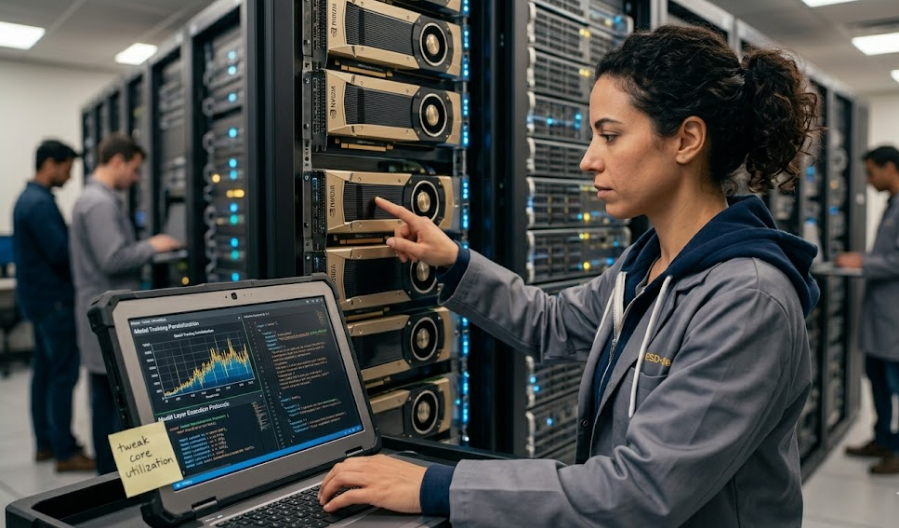
Modern AI looks magical from the outside.
You type a question into a chat box. Seconds later, a model writes code, summarizes legal documents, or explains quantum physics in plain English. It feels abstract — almost weightless.
But underneath all that software is an absurd amount of hardware doing brutal mathematical labor.
And almost all of it depends on GPUs.
That’s why companies are suddenly fighting over graphics cards like they’re strategic military resources. Because, in a strange twist, the hardware originally built for rendering video games became the foundation of the AI economy.
Not by accident. By architecture.
What a GPU Actually Is
A GPU — Graphics Processing Unit — was originally designed to render images and video efficiently.
Video games require millions of tiny calculations happening simultaneously:
- lighting
- shadows
- textures
- physics
- movement
CPUs could handle these tasks, but not fast enough for modern graphics.
So GPUs were built differently.
CPUs vs GPUs
A CPU is optimized for sequential tasks:
- running operating systems
- handling logic
- executing varied instructions
It’s like a highly skilled manager handling one complex problem at a time.
A GPU is optimized for parallel tasks:
- thousands of small calculations simultaneously
- repetitive mathematical operations
- large matrix computations
It’s less like a manager and more like an enormous factory floor.
That architectural difference is exactly why AI workloads fit GPUs so well.
AI Is Mostly Math at Massive Scale
This is the part many beginners miss.
Modern AI models are fundamentally giant mathematical systems.
Training a neural network involves:
- matrix multiplication
- vector operations
- probability calculations
- gradient updates
over and over and over again.
Millions. Billions. Sometimes trillions of times.
Why Parallelism Matters
These calculations can often happen simultaneously, which makes GPUs dramatically faster than CPUs for AI workloads.
A CPU might solve a few complicated problems quickly.
A GPU solves thousands of simpler problems all at once.
That distinction changes everything.
Without GPUs, training modern AI models would take impractically long. Some models that train in weeks today might otherwise require years.
The rise of GPUs is closely tied to the emergence of modern LLMs, which I explain in Breaking the Magic: How Large Language Models Actually Work.
The Deep Learning Explosion Was Also a Hardware Story
People often talk about AI progress as if researchers suddenly discovered smarter algorithms.
That’s only part of the story.
A huge reason modern AI accelerated after the 2010s was that hardware finally became powerful enough to support deep learning at scale.
The Timing Wasn’t Coincidental
Three things converged:
- larger datasets
- improved neural network techniques
- massively parallel GPU computing
Without all three, today’s AI boom probably doesn’t happen.
This is one reason NVIDIA became one of the most strategically important companies in the world almost accidentally. Their GPUs happened to be unusually well-suited for machine learning workloads before most people realized machine learning would dominate computing.
Sometimes technological revolutions begin sideways.
Training AI Models Is Incredibly Expensive
When people hear that advanced AI models require “compute,” it sounds abstract.
The reality is more physical and industrial than most imagine.
Training frontier AI models can require:
- thousands of GPUs
- enormous data centers
- massive electricity consumption
- sophisticated cooling systems
- high-speed networking infrastructure
This isn’t somebody running Python on a laptop anymore.
Why Compute Became a Competitive Advantage
Large AI companies now compete partly on access to compute infrastructure.
Because better models increasingly require:
- more training data
- larger parameter counts
- longer training runs
- faster inference systems
The cost barrier is enormous.
That creates an unusual situation where hardware availability directly shapes AI progress.
If you're looking for a simpler explanation of why large models are so powerful, see Large Language Models Are Basically Autocomplete at Absurd Scale.
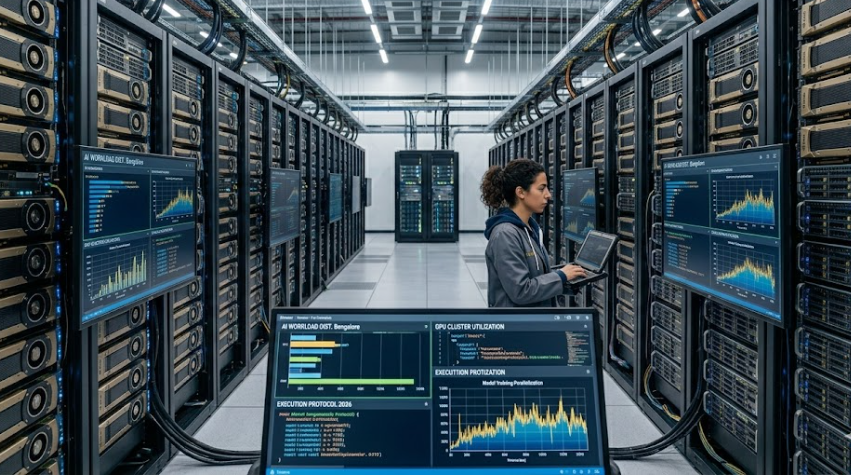
GPUs Matter for Inference Too
Most people focus on training, but GPUs are equally important during inference — the moment AI generates outputs for users.
Every ChatGPT response, image generation request, or AI coding suggestion requires live computation.
At global scale, that becomes incredibly demanding.
Why AI Feels Expensive to Run
AI products don’t behave like traditional software.
A normal app might:
- retrieve data
- display interfaces
- process lightweight logic
AI systems actively generate outputs in real time through massive mathematical operations.
That means every user interaction consumes compute resources.
This is one reason many AI businesses struggle with margins. Inference costs can become surprisingly large as usage grows.
The smarter the model, the more expensive the conversation often becomes.
Why GPUs Created a Supply Chain Panic
Around 2023–2025, GPUs effectively became the oil of the AI industry.
Demand exploded faster than manufacturing capacity.
Suddenly:
- startups couldn’t access hardware
- cloud prices surged
- countries worried about chip access
- governments introduced export controls
- companies stockpiled compute resources
This wasn’t normal tech hype anymore. It became geopolitics.
AI Depends on Physical Infrastructure More Than People Realize
One interesting misconception about software is that it feels detached from physical reality.
AI breaks that illusion.
Modern AI progress depends heavily on:
- semiconductor manufacturing
- energy grids
- cooling systems
- rare materials
- global supply chains
The “cloud” eventually lands in a warehouse full of very hot machines.
Why NVIDIA Dominated the AI Boom
People sometimes ask:
Why didn’t another chip company win instead?
Partly because NVIDIA solved the ecosystem problem early.
They didn’t just build hardware. They built software tooling around it.
CUDA Quietly Became a Moat
NVIDIA’s CUDA platform allowed researchers and engineers to program GPUs efficiently for machine learning tasks.
Over time, the entire AI ecosystem accumulated around it:
- frameworks
- libraries
- research tooling
- optimization pipelines
That created lock-in.
By the time the AI explosion fully arrived, much of the industry was already built around NVIDIA infrastructure.
This is one of those cases where developer ecosystems mattered as much as raw hardware performance.
Could GPUs Eventually Be Replaced?
Possibly.
Specialized AI chips are already emerging:
- TPUs (Tensor Processing Units)
- AI accelerators
- neuromorphic chips
- custom inference hardware
Many companies want alternatives because GPUs are:
- expensive
- power-hungry
- supply-constrained
But Replacing Infrastructure Is Hard
The challenge isn’t just building faster chips.
It’s rebuilding:
- software ecosystems
- developer tools
- cloud infrastructure
- optimization frameworks
- deployment pipelines
Technology stacks become sticky surprisingly fast.
So while alternatives are growing, GPUs remain dominant largely because the surrounding ecosystem matured alongside them.
The Hidden Constraint in AI Is Energy
This part gets less attention than it should.
AI isn’t constrained only by algorithms or talent.
Increasingly, it’s constrained by electricity.
Training and running large AI systems consumes enormous power.
That creates uncomfortable questions:
- Can power grids support large-scale AI growth?
- How sustainable are current compute trends?
- Will energy become the real bottleneck?
The industry talks constantly about smarter models. Less often about the physical cost of running them.
But eventually physics sends the invoice.
GPUs Matter Because AI Is Physical, Not Magical
There’s a tendency to discuss AI as if it exists entirely in software.
But every generated sentence, image, or prediction comes from hardware performing staggering amounts of mathematical work in real time.
GPUs became essential because they happen to match the structure of modern AI computation unusually well.
That compatibility reshaped entire industries:
- cloud computing
- semiconductor manufacturing
- startup economics
- geopolitics
- energy infrastructure
And strangely enough, it all traces back to hardware originally optimized so video games could render explosions more smoothly.
Technology evolves like that sometimes.
The future arrives through side doors nobody initially takes seriously.