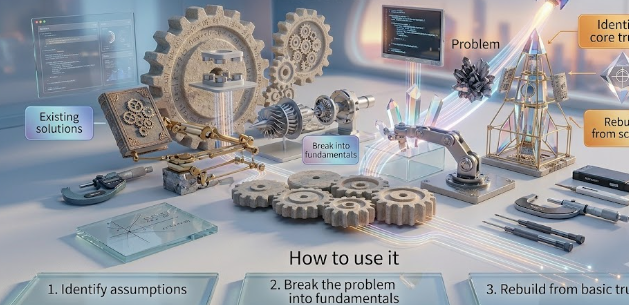
Most people don't think from first principles. They think from analogy.
That isn't a criticism. It's just how humans are wired. We learn by copying what already exists, reusing patterns that seem to work, and making small adjustments. It’s efficient, and most of the time it’s good enough.
The problem is that analogy can quietly become a trap. You stop asking whether something is actually true and start asking whether it is normal. That’s usually where better thinking begins—when you start questioning what everyone else has stopped noticing.
Analogy vs First Principles
Imagine someone wants to start a coffee shop.
Most people begin by studying existing coffee shops: what they charge, how they design their space, what they sell, and how they operate. This is analogy-based thinking. You’re copying a working template.
First principles thinking starts differently. It asks:
What problem is a coffee shop actually solving?
Maybe people want caffeine. Maybe they want a place to work. Maybe they want a social environment. Maybe they just want a daily ritual that feels familiar.
Once you reduce the idea to its basic components, the space of possible solutions expands. You’re no longer copying coffee shops—you’re solving human needs.
Most people think success comes from better ideas, but in reality execution matters more. This is similar to what I discussed in Stop Looking for Startup Ideas.
Why Most Assumptions Go Unquestioned
One of the strangest things about adulthood is how many systems exist without anyone remembering why they exist.
Businesses copy competitors. Employees copy previous employees. Founders copy successful founders. Over time, the reasoning disappears, but the behavior remains.
This creates invisible constraints. Everyone is optimizing inside rules nobody remembers choosing.
A few examples:
| Common Assumption | First Principles Question |
|---|---|
| Meetings are necessary | What information actually needs to be exchanged? |
| Degrees are required | What skills are actually needed for the work? |
| Offices improve productivity | Under what conditions do people actually focus better? |
| More features create better products | What problem is the user actually trying to solve? |
The goal is not to reject all norms. Many exist for good reasons. The goal is to understand them before accepting them.
The Five-Why Technique
A simple way to practice first principles thinking is to repeatedly ask “why.”
Example:
I want to earn more money.
Why?
Because I want financial freedom.
Why?
Because I want control over my time.
Why?
Because I don’t want to feel stuck in one job.
Why?
Because autonomy matters more to me than status or stability.
At the surface level, this looks like a money problem. But underneath, it’s a freedom problem.
That shift matters. Because solving for money and solving for autonomy can lead to very different decisions.
The deeper you go, the more likely you are to find the real constraint you’re actually trying to solve.
Where First Principles Thinking Actually Helps
This idea is often associated with innovation or startups, but most of its value shows up in everyday decisions.
In careers, it helps separate what society values from what you actually want. In productivity, it reveals that the goal isn’t doing more tasks, but making meaningful progress. In business, it prevents people from copying solutions without understanding the underlying problem.
A lot of startup failures happen for exactly this reason: people copy successful products instead of understanding why those products worked in the first place.
They recreate the surface, not the structure. Most people confuse effort with direction. This connects closely with Why Consistency Beats Talent.
The Limit of First Principles Thinking
First principles thinking is sometimes treated like a superpower. It isn’t.
If you applied it to everything, life would become slow and exhausting. You don’t need to reinvent how toothbrushes work or redesign your calendar system from scratch.
Most of the time, analogy-based thinking is perfectly fine. It saves time and energy.
The real skill is knowing when to switch modes.
Use analogy when the problem is already well understood. Use first principles when you suspect the assumptions underneath the problem might be wrong.
That judgment is more valuable than the method itself.
Final Thought
First principles thinking doesn’t guarantee better answers. It just increases the chance that you’re asking the right questions.
Most people spend their time improving existing assumptions. Occasionally, someone stops and asks whether those assumptions were correct to begin with.
That’s often where better ideas start—not from optimization, but from clarity.