The Dunning-Kruger Effect Isn’t About “Stupid People Being Confident”
There’s a certain kind of person everyone thinks they can spot.
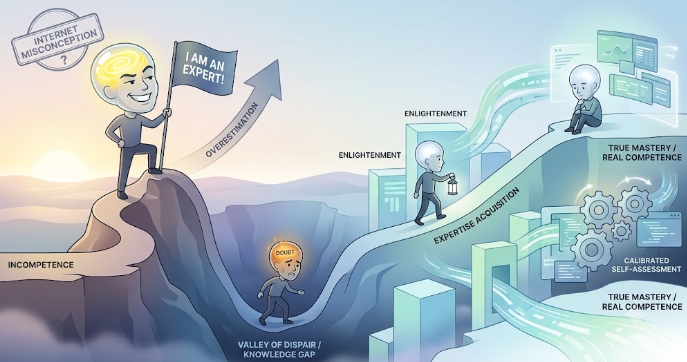
They talk big, make bold claims, radiate certainty—and seem completely unaware of how wrong they might be. The internet turned this into a meme: the Dunning-Kruger effect, often summarized as “people with low ability overestimate their competence.”
It’s neat. Too neat.
Because once you spend enough time watching real people learn real things—coding, investing, writing, managing teams—you start noticing something more uncomfortable: confidence doesn’t track with ability in any clean way. And the story we tell about Dunning-Kruger is often a shortcut that hides more than it reveals.
The actual idea is smaller—and sharper—than the meme
The original research by David Dunning and Justin Kruger (1999) wasn’t trying to describe a personality type. It was studying a very specific cognitive failure: people with low skill in a domain often lack the metacognitive ability to recognize their own mistakes.
In plain terms: if you don’t know what good looks like, you also struggle to see how far you are from it.
That’s it.
Not “ignorant people are arrogant.” Not “smart people are humble.” Just a mismatch between skill and self-awareness in specific contexts.
And importantly, the effect shows up most clearly in narrow tasks—grammar tests, logic problems, humor judgments—where “correctness” can actually be measured.
The internet took that lab result and stretched it into a personality theory. That’s where things get messy.
It’s the same kind of oversimplification problem you see when people assume AI is just smarter autocomplete, rather than what’s described in Large Language Models Are Basically Autocomplete at Absurd Scale
Why the meme version feels true anyway
There’s a reason people believe it so easily. We’ve all met someone wildly overconfident and underqualified. Sometimes they’re in meetings. Sometimes they’re in comment sections. Sometimes they’re running the meeting.
But here’s the uncomfortable twist: we also ignore the opposite pattern just as often.
Highly skilled people frequently underestimate their competence, especially in environments where standards are unclear or constantly shifting. They assume “everyone can do this” because, to them, the hard parts feel automatic.
This shows up in different forms depending on the system you’re looking at — whether it’s human thinking or machine behavior, the gap between intuition and reality is a recurring pattern, like in Breaking the Magic: How Large Language Models Actually Work
This creates a distorted visibility problem:
- Low skill + low awareness = loud certainty
- High skill + high awareness = quiet doubt
- High skill + low communication = invisible competence
So what we perceive as “Dunning-Kruger in action” is often just asymmetry in visibility and communication.
The loudest voice in the room is rarely the most calibrated one.
The part people miss: confidence isn’t the same as ignorance
One of the more subtle misunderstandings is assuming that overconfidence always comes from lack of knowledge.
Sometimes it does. But often it comes from something else entirely: lack of feedback that actually hurts.
If you work in an environment where mistakes are not clearly punished—or where feedback is delayed, noisy, or socially softened—you can maintain inflated confidence for a long time. This is especially common in modern knowledge work.
Think about it:
- A developer ships bad code that only breaks in edge cases weeks later
- A manager makes a poor decision whose consequences are distributed across a quarter
- A content creator gets likes, but no signal about depth or correctness
In all these cases, reality is slow to respond. And when reality is slow, confidence drifts.
This is not ignorance. It’s a feedback delay problem.
A more useful way to think about it: calibration, not competence
A more practical lens than Dunning-Kruger is calibration: how closely your confidence matches reality.
People aren’t simply “wrong or right” in their self-assessment. They’re often miscalibrated in predictable ways depending on context.
There’s a pattern worth noticing:
- Beginners tend to oscillate wildly between overconfidence and confusion
- Intermediate learners are often the most uncertain
- Advanced practitioners are usually calm—but not always correct
That “intermediate dip” is interesting. It’s where people learn enough to see complexity but not enough to resolve it. Confidence drops, not because ability drops, but because awareness expands faster than competence.
This is one of the least intuitive parts of learning: feeling less confident can be a sign of progress.
The deeper issue isn’t confidence itself, but the fact that most people never question their starting assumptions — which is exactly what What Is First Principles Thinking? (And How to Use It) tries to fix.
Why smart people still fall into it (just differently)
Here’s a less comfortable observation: the Dunning-Kruger effect doesn’t disappear with intelligence. It just changes shape.
Highly capable people can still be deeply miscalibrated in unfamiliar domains. The difference is that they’re better at hiding it—sometimes even from themselves.
Two common failure modes show up:
-
Domain substitution Someone is skilled in one area and unconsciously assumes that skill transfers cleanly to another. (Good engineer → assumes they understand product strategy deeply after a few meetings.)
-
Model overconfidence Someone builds a mental model that works “well enough” early on, then stops updating it because it feels internally consistent.
The trap isn’t stupidity. It’s early closure. The feeling that a model is complete before it has been stress-tested.
This is where experience can actually become dangerous if it turns into rigidity.
What actually helps: building better self-correction loops
If there’s a practical takeaway, it’s not “be more humble” or “assume you’re wrong.” Those are slogans, not tools.
What actually improves calibration is exposure to honest error signals.
A few patterns matter more than people expect:
- Working in environments where mistakes surface quickly
- Seeking feedback from people who don’t benefit from your agreement
- Keeping artifacts of past thinking (old code, old notes, old decisions) and revisiting them
- Deliberately testing your assumptions in small, reversible ways
The goal isn’t to eliminate misjudgment—that’s impossible. The goal is to shorten the time between being wrong and realizing it.
Because the real distortion in thinking isn’t confidence itself. It’s unquestioned confidence that lasts too long.
The gap between perception and reality tends to shrink only when people stick with something long enough to get honest feedback — the same idea behind Why Consistency Beats Talent.
The quieter insight behind the whole idea
The Dunning-Kruger effect gets misused because it flatters everyone a little. It lets skilled people feel superior to “obvious overconfidence,” and it lets inexperienced people dismiss their uncertainty as temporary.
But the more honest reading is less satisfying: most people are miscalibrated in different directions depending on context, incentives, and feedback quality.
And the boundary between confidence and competence is not a line—it’s a moving average shaped by experience and environment.
The real question isn’t “Who is overestimating themselves?”
It’s “Where are the feedback loops too weak to correct us in time?”